Site lighting, electrical, communications or any other underground installation. We have the equipment and the experience to open the trench your drawings call for and keep your schedule on track.
Utility trenching is the open-cut excavation of a narrow, continuous trench so conduit, cable or pipe can be placed below grade, then bedded, backfilled and covered. Premier Underground trenches for electrical, communications and site lighting across Arizona, in any size, and handles the cutting, hauling and restoration around the trench.
01 — What it is
When do you need a trenching contractor?
You need one whenever power or communications has to get from one point to another below the surface and the route can be opened from above.
Open trench is the most direct way to put dry utilities in the ground. The whole route is visible, the conduit can be laid, spaced and inspected before it is covered, and the trench can be sized for one conduit or for several systems stacked in layers.
It is also where an underground schedule is won or lost. A trench that is the wrong width, off line, or left open waiting on another trade holds up everyone behind it. That is why electrical contractors, general contractors, developers and renewable energy contractors hand the trench to a crew that does nothing else.
Typical reasons customers call us:
Primary and secondary electrical feeds to a new building or campus
Communications and fiber conduit, including relocations
Site lighting and camera circuits across parking lots and roadways
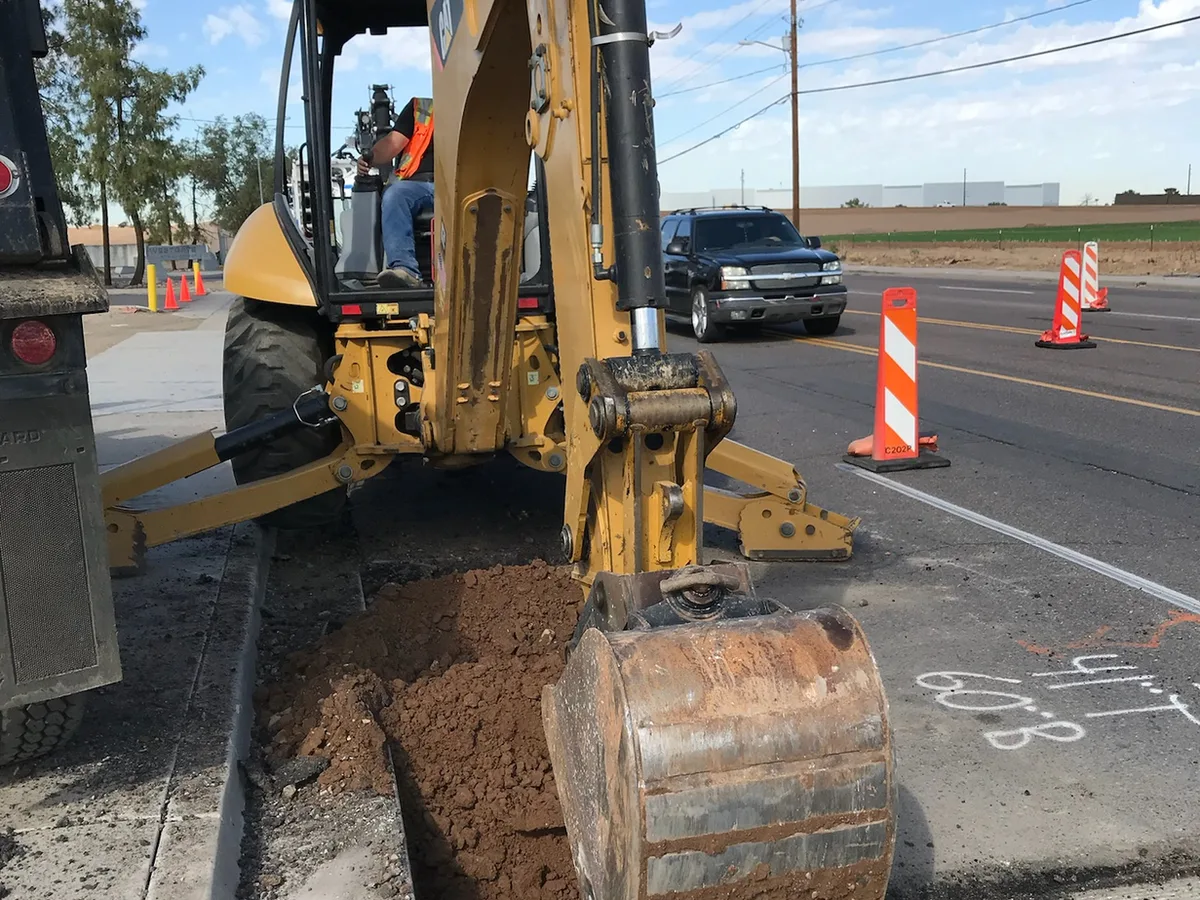
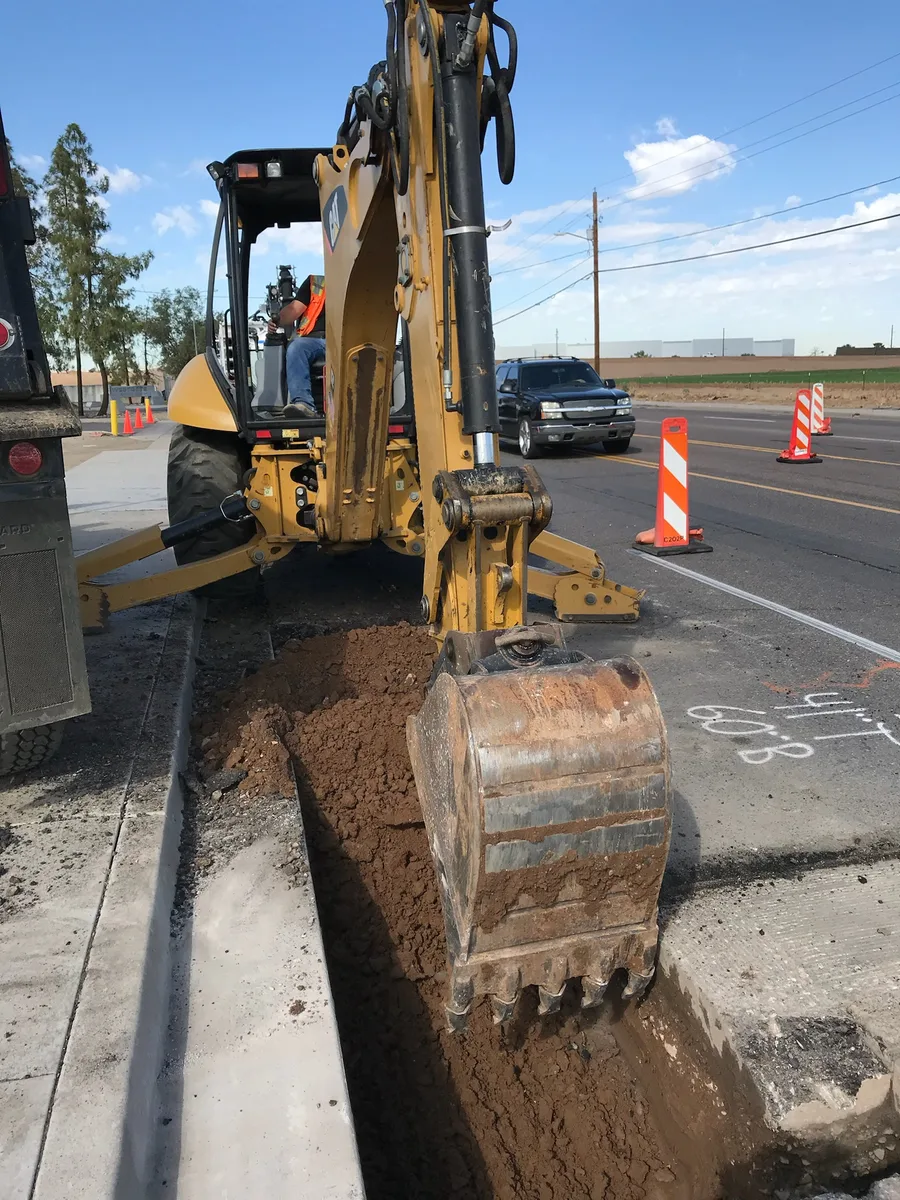
A narrow trench along a saw-cut road edge, with traffic control in place.
02 — Trench types
What kind of trench does your job need?
The utility decides the trench. Width, depth, bedding and backfill all follow from what is going in and whose specification governs it. These are the trenches we are asked for most.
Trench
Used for
What usually goes with it
Narrow utility trench
Site lighting, camera circuits and single communications or electrical conduit runs
Not sure which applies? Send the drawings. The utility provider's or engineer's specification usually answers it, and our estimators read those every day.
03 — Scope
What is included in a Premier trench.
As much or as little as you want. We can hand you an open trench ready for your electricians, or carry everything from the first cut to the finished surface.
Layout of the route from your drawings
Saw-cutting and removal of pavement, sidewalk or slab over the route, indoors or outdoors
Trench excavation to the width and depth the installation calls for
Hammers and rock trenchers where the ground is hard
Trench protection and safe access once depth calls for it
Bedding and shading material, placed in layers where the design stacks systems
Conduit and duct bank installation, when it is part of our scope
Backfill, and spoils haul-off in our own dump trucks
Sidewalk, curb and asphalt returned to original condition, coordinated for you
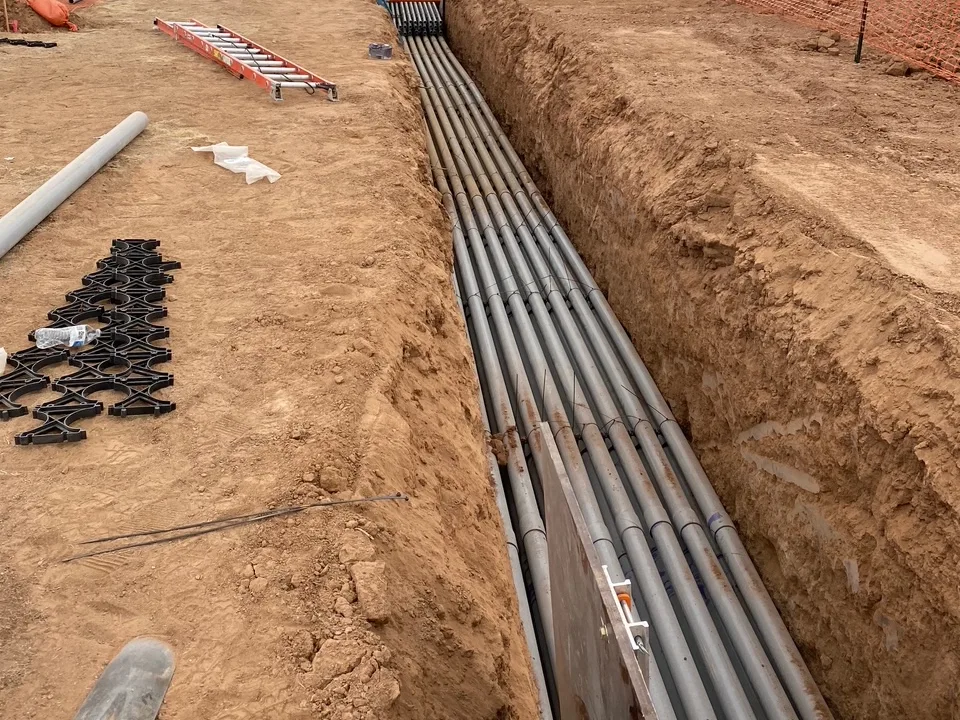
A straight trench, a conduit bank on spacers and barrier fence along the open edge.
04 — Method
How we run a trenching job.
Trenching looks simple from the road. Keeping a long trench safe, on line and moving every day takes a routine, and ours is the same on a one-day service call as on a data center.
Preconstruction
Price the real trench
Our estimators work from your drawings and specifications and price the full scope, including hard ground, haul-off and restoration, so the number holds up in the field.
Hand-off
Carry your requirements across
Your requests, schedule and needs are written into the contract and handed from preconstruction to the project manager who will run the job.
Operations
Line up material, equipment and crew
Material is procured ahead of need. Equipment, tools and people are scheduled so the right resources reach the right task at the right time.
Every day
Plan, then dig
Each day starts with a job safety analysis and an operations meeting. Field leadership completes a trench inspection daily, and all of it is recorded digitally.
Fleet
Keep the iron working
In-house mechanics look after our equipment and vehicles, so a breakdown does not turn into a hole in your schedule.
Quality
Check before it is covered
Quality control visits the site while there is still time to adjust direction, then walks the finished work with operations at close-out.
Our rules around an open trench: 3, 4, 5, 6
Spoil stays 3 feet back from the edge. A safe way in and out at 4 feet. Trench protection at 5 feet. Fall protection at 6 feet. These are Premier's core rules on every job, every day, whatever the size of the project. Read more about our safety program.
05 — Proof
Trenching projects, from solar fields to a hospital campus.
Three jobs where the trench was the scope, and where the ground, the specification or the neighbors made it harder than a line on a drawing.
Trenching for direct-buried DC and AC. We placed multiple layers of bedding and shading so DC, AC, fiber optics and grounding could each be installed at their own level.
Military · Luke Air Force Base
Luke AFB F-35
B & D Industries
3Systems trenched: primary, secondary, low voltage
USACESpecifications coordinated
Trenching for underground power distribution, followed by medium-voltage and service raceways and communications conduit. The work was coordinated with the Corps of Engineers and the local utility providers.
Healthcare · Arizona
Banner Behavioral Health
Delta Diversified / Oakland
2New feeds: primary and secondary
APSUtility provider specification
Trenching for a new primary and secondary feed through a highly congested area with critical paths. All underground conduit systems were installed to the specification of the utility provider, Arizona Public Service.
06 — Quick answers
Trenching questions we hear before a bid.
What size trench can Premier Underground dig?
Any size the installation calls for. We dig narrow trenches for site lighting and communications, and wide ones for stacked or side-by-side systems. On the Mohave Solar project our trenches ranged from 24 inches up to 9 feet wide.
Do you only dig the trench, or do you install the conduit too?
Either. Some customers want an open trench ready for their own electricians. Others hand us the whole underground scope: trench, conduit or duct bank, bedding, backfill and restoration. Tell us where you want the line drawn and we will price it that way.
What happens when the trench runs into rock or caliche?
We bring in the hard dig equipment. Premier Underground runs backhoe hammers, excavator hammers and rock trenchers, so hard ground changes the method, not the contractor. Share any soils information you have when you request a quote so the estimate reflects the real ground.
Can you trench across a road or driveway that has to stay open?
When open cut is not possible, we use horizontal directional drilling to install the pipe or conduit under the crossing instead. Many jobs combine the two: open trench where the ground is clear, and a bore under each road or driveway.
Where in Arizona do you provide trenching?
Statewide. Premier Underground is headquartered in Avondale, in the Phoenix metro area, and takes on trenching work across Arizona.
Send the drawings and the schedule. Our estimators will price the trench you actually need, including the hard ground, the haul-off and the patch-back.