
Service 08
Saw-cutting, demolition and breaking in Arizona
Laying underground utilities starts with opening the surface. We cut the asphalt and concrete, break out what is in the way, load it and haul it off, so the trench starts on time.
In short
Saw-cutting, demolition and breaking are the work that clears the way for a trench or excavation. Premier Underground cuts asphalt and concrete in straight lines, indoors or outdoors, breaks out sidewalks, footers and pole bases, and removes and hauls off the debris so underground utility installation can begin.
01 — What it is
What saw-cutting and demolition cover on an underground job
Most utility routes do not cross open dirt. They cross parking lots, streets, sidewalks and building slabs, and sometimes the remains of whatever was built there before.
Before a bucket goes in the ground, the surface has to be opened cleanly and the obstructions have to come out. That takes more than one machine. It takes a saw to cut, a hammer to break, a loader or backhoe to pick up, and a truck to carry it away. Having that equipment available on the same schedule is what keeps the route from becoming the delay.
We offer these services so your trenching or excavation can start without waiting on a separate cutting or demolition contractor. One crew opens the surface and the same company digs behind it.
02 — Scope
Three kinds of work, one crew
Cutting, demolition and breaking overlap on site. Here is how we separate them when we price and plan a job.
Saw-cutting
Straight cuts through asphalt and concrete along the limits of the trench or excavation. We cut outdoors in streets, drives and parking areas, and indoors through existing building slabs.
Demolition and removal
Taking out what sits inside the cut lines and anything else in the path. The material is picked up, loaded and removed from the route, not left in piles for someone else.
Breaking
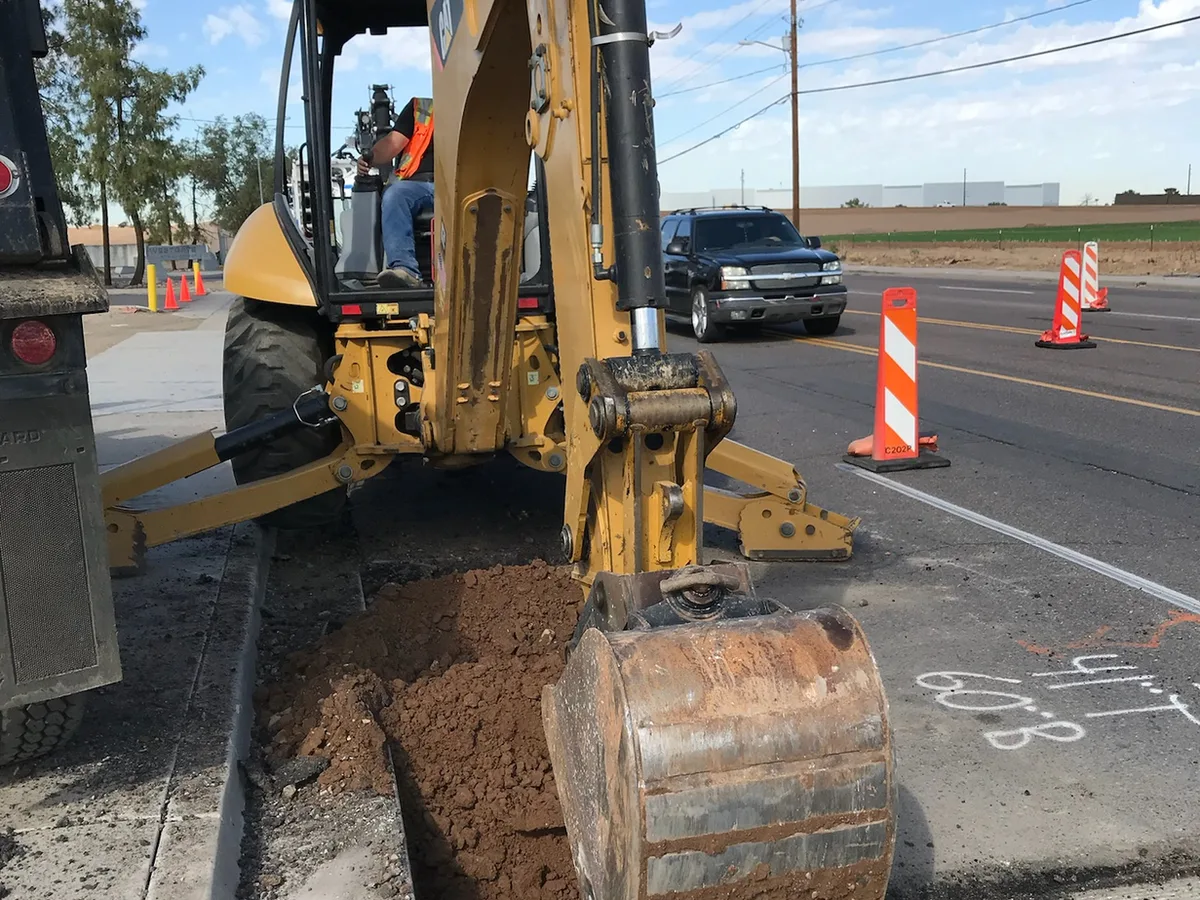
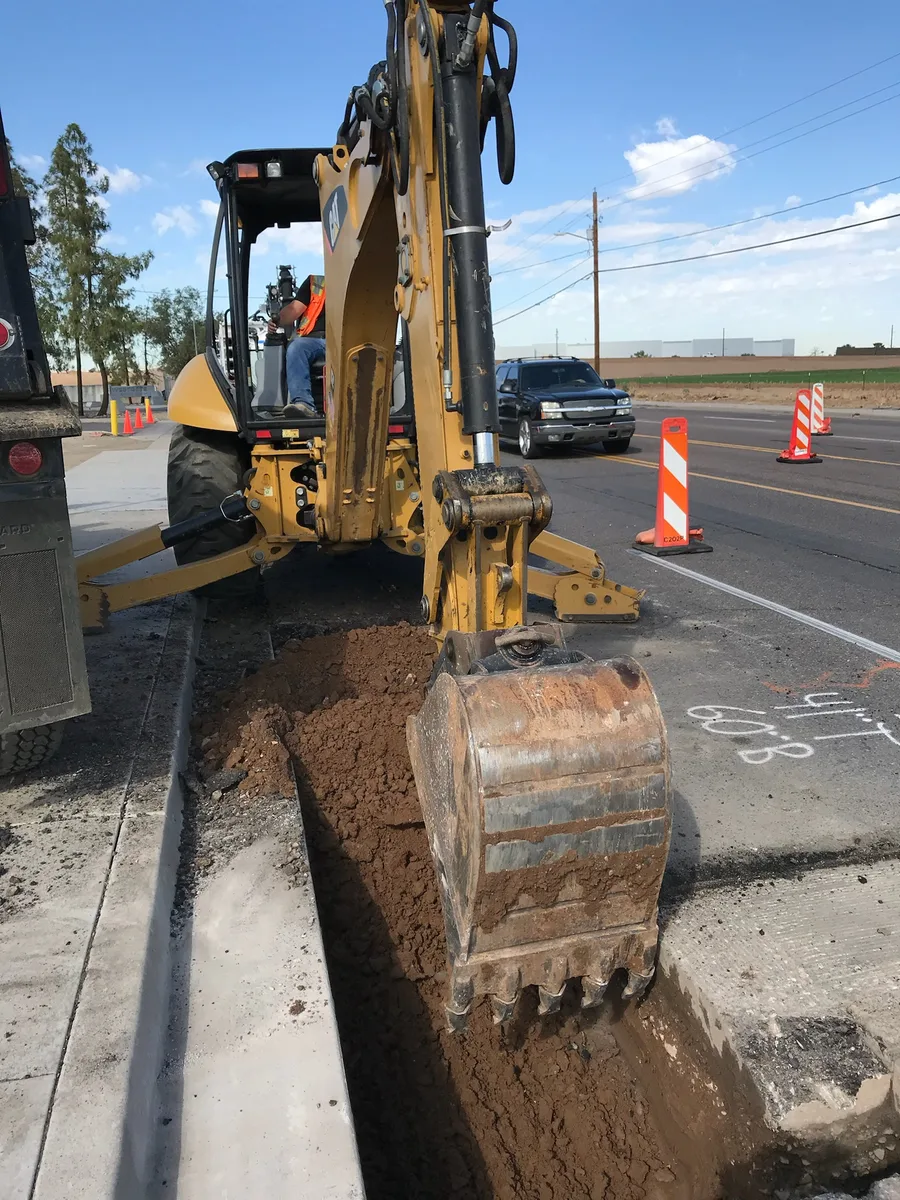
Hydraulic hammers on backhoes and excavators for the thick and reinforced pieces: sidewalks, footers and pole bases that a saw and a bucket alone will not move.
What is included
When this scope is part of your package, the estimate covers the whole sequence from the first cut to a clear route.
- Layout of cut lines to match the trench or excavation limits
- Asphalt and concrete saw-cutting, outdoors and inside buildings
- Breaking and removal of sidewalks, footers and pole bases
- Removal of other obstructions in the utility path
- Loading and haul-off of debris in our own dump trucks
- Coordinated surface restoration once the utilities are in
03 — Method
How we open a surface for underground utilities
The cut is the first thing your owner, your tenant or the public sees of the underground work. We plan it with the trench, not as an afterthought.
- Preconstruction
Price the surface with the trench
Our estimators read the route for what it crosses and include cutting, breaking, removal and haul-off in the estimate. At hand-off, your requests, schedule and needs go to the project manager in writing.
- Planning
Lay out the cut and check the ground
Cut lines are marked to the trench limits. In congested or unknown areas we can pothole first with vacuum excavation, so the saw and the hammer are not the first things to find a buried line.
- Field
Cut
The crew cuts straight lines through the asphalt or concrete. Indoor cuts are planned around the building: access, working hours and what the space is used for.
- Field
Break, load and haul
Hammers break out the slab, sidewalk, footer or pole base. The debris is loaded and hauled off, and the route is left clear for the excavation crew.
- Field
Trench or excavate
Digging starts behind the cut. Field leadership completes daily trench inspections and job safety analyses and records them digitally, the same as on every Premier job.
- Quality
Restore and close out
Restoration is coordinated to bring the surface back to original condition. Quality control visits the site and walks the finished work with operations before close-out.
04 — Choosing the approach
Cut through it, break it out, or go under it?
Cutting is not always the answer. What the route crosses, and whether it can be closed while we work, decides the method.
| What is in the way | Usual approach | What to plan for |
|---|---|---|
| Asphalt lot, drive or street that can be opened | Saw-cut both edges, remove the strip, trench, then patch back | Traffic control, haul-off and asphalt patch-back |
| Existing building slab | Indoor saw-cut, remove the slab section, trench inside the building | Access, working hours, and the building's limits on dust, water and noise |
| Sidewalk, footer or old pole base | Break out with a backhoe hammer or excavator hammer and remove | Room to work the machine, and replacement of the sidewalk afterward |
| Road or driveway that has to stay open | Horizontal directional drilling under the surface, with no cut | Space for the drill at each end of the crossing |
| Rock or cemented ground below the pavement | Cut the surface, then move to hard dig equipment | Slower production than soil, which belongs in the estimate from the start |
05 — Safety and quality
Same rules on a one-day cut as on a data center
Cutting and breaking jobs are often short. That does not change how we run them. Safety does not have a project size requirement at Premier: it is prioritized on every job, every day. Our approach fits in four words: train. equip. monitor. train again.
We certify our operators to do this work safely, and our in-house mechanics keep the equipment working so a breakdown does not hold up your schedule.
What to send us for a quote
The more we know about the surface, the tighter the number. Useful details:
- Plans showing the utility route and what it crosses
- Surface type and thickness, if known
- Known obstructions: footers, pole bases, abandoned structures
- Indoor or outdoor work, and any limits on hours or access
- Who is responsible for restoration, and to what standard
06 — Questions
Saw-cutting and demolition questions
Why is pavement saw-cut before trenching?
A saw-cut gives the trench a straight, clean edge. The pavement inside the cut lines comes out, and the pavement outside them stays intact instead of cracking and lifting with the bucket. It also leaves a sound, square edge for the patch to meet when the surface is restored.
Can you saw-cut inside an existing building?
Yes. We saw-cut for both indoor and outdoor building areas. Indoor cutting is common when new conduit has to run under an existing slab. Tell us about access, working hours and any dust, water or noise limits in the building so we can plan the cut around them.
What kinds of obstructions do you break out and remove?
Sidewalks, footers and pole bases are the most common. We also remove other obstructions in the path of a trench or excavation. The work is done with backhoe hammers and excavator hammers, matched to the size of what has to come out and the room there is to work.
Do you haul away the broken asphalt and concrete?
Yes. Saw-cutting, removal and haul-off go together. We load the debris into our own dump trucks, which range from 5 to 35 tons, so the route is clear before trenching starts.
Who puts the surface back after the utilities are in?
We coordinate it for you. When sidewalk, curb or asphalt has to go back to original condition, Premier coordinates each restoration task as part of the same package, so the cut, the trench and the patch are managed by one team.
Related services
Your job. Your way.
Something in the way of your trench?
Send us the plans and tell us what the route crosses: asphalt, slab, sidewalk, footers or old pole bases. We price the cutting, breaking, removal and haul-off with the trench, so it arrives as one number.
575 N Eliseo Felix Jr Way, Avondale, AZ 85323
623-748-9650 · estimating@
Serving all of Arizona since 2004