
Service 05
Horizontal directional drilling in Arizona
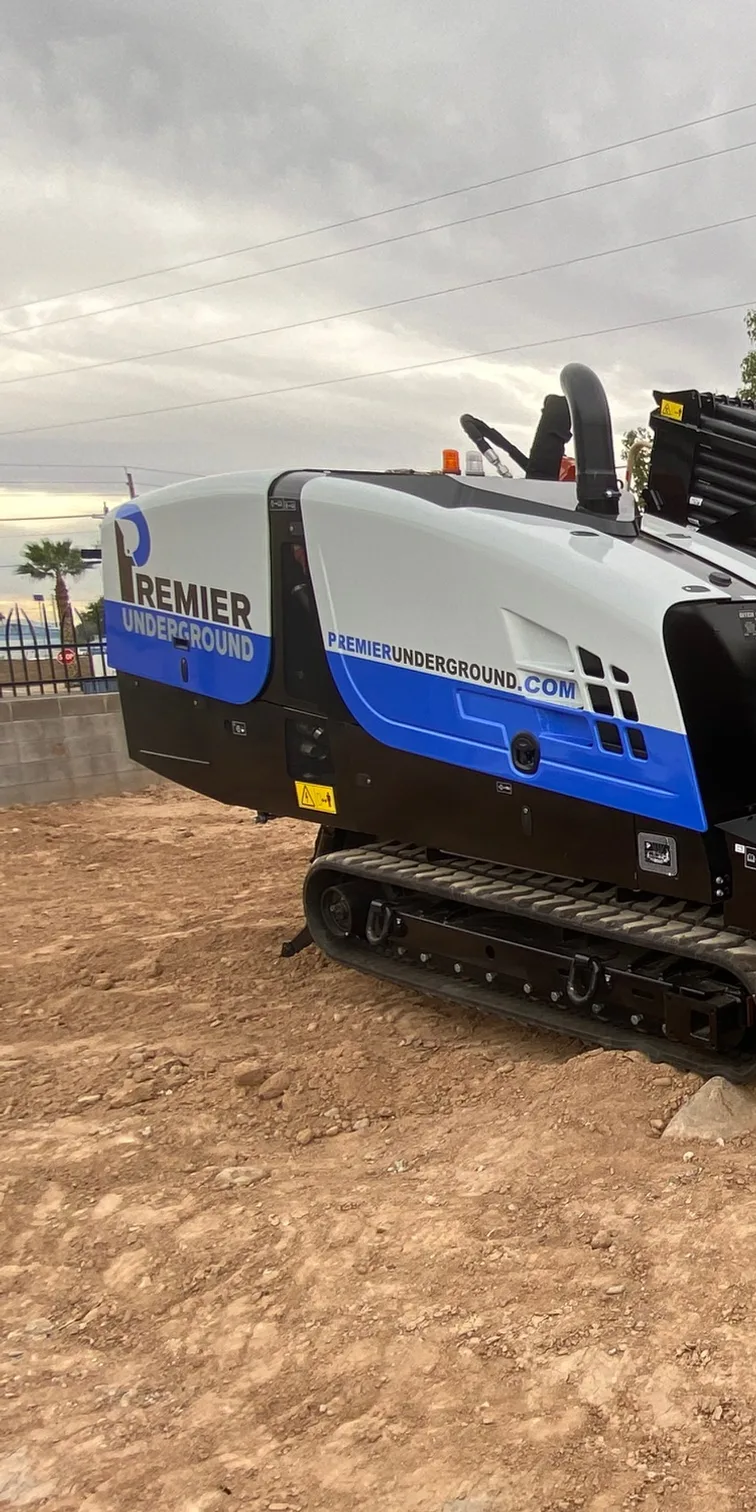
Need to cross driveways or roads and maintain flow? When open cut is not possible, we bore under the obstacle and pull your pipe or conduit through, while traffic keeps moving above.
In short
Horizontal directional drilling (HDD), also called directional boring, installs pipe or conduit underground without digging a continuous trench. A drill rig steers a pilot bore beneath the obstacle from an entry point to an exit point, enlarges the hole, then pulls the pipe back through. The road, driveway or landscaping above stays in place and in use.
01 — What it is
A way across when you cannot cut the surface.
Most conduit goes in an open trench, and most of the time that is the right call. Directional drilling is for the stretch where a trench is not allowed, not practical or not worth what it would cost to put the surface back.
That usually means a crossing. A road that has to stay open. A driveway a business depends on. A finished entry, a wash, a rail line or a row of mature trees. Instead of saw-cutting, trenching and patching, the rig sets up on one side, drills underneath and comes up on the other.
We offer horizontal directional drilling for any of your underground pipe or conduit systems, on its own or as one piece of a turnkey dry utility package. On most jobs the bore is a short link in a longer run, with open trench on both sides of it.
You are probably looking at a bore if
- The road owner will not permit an open cut, or the pavement is new
- Closing a lane or a driveway would stop a business or a site from working
- Restoring the surface would cost more than the conduit run itself
- The route passes under something that cannot be moved or rebuilt
02 — How a bore works
Pilot bore, reaming, pullback.
Every directional bore follows the same three stages, whether it carries one small conduit under a driveway or a larger pipe under a wide road.
- Stage 1
Pilot bore
The rig pushes and rotates a string of drill rods into the ground at a shallow angle. The drill head at the front can be steered, and a transmitter behind it lets a locator on the surface track its position and depth as it goes. The operator guides the head down, level under the obstacle, and back up to the planned exit point.
- Stage 2
Reaming
At the exit, the drill head comes off and a reamer goes on. The reamer is pulled back toward the rig, cutting the pilot hole out to a diameter larger than the pipe it will hold. Bigger installations can take more than one pass. Drilling fluid pumped through the rods carries the cuttings out and helps keep the hole open.
- Stage 3
Pullback
The pipe or conduit is laid out at the exit side and connected behind the reamer with a swivel, so the pipe is pulled rather than twisted. The rig then draws the whole string back through the bore in one continuous pull. Each end is exposed and tied in to the rest of the run.
What you see on the surface
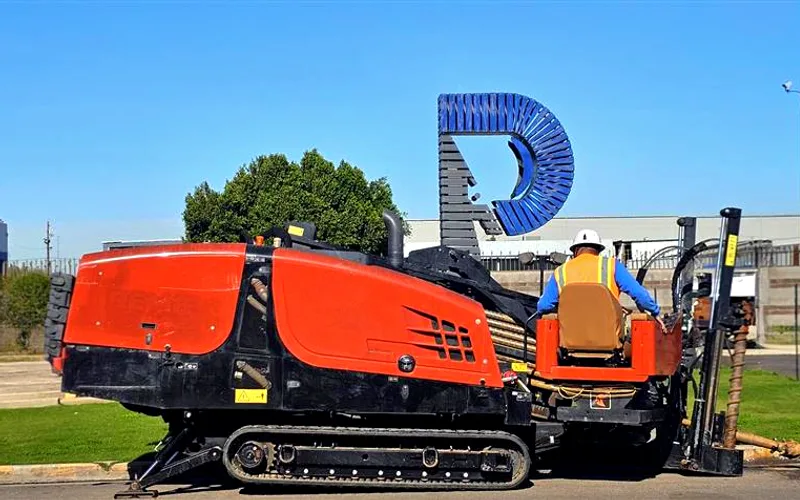
A work area at the entry side for the rig, a smaller one at the exit side where the pipe is laid out, and a pit at each end for the tie-in. The ground between them is not disturbed.
03 — Choosing a method
Directional drilling vs open trench.
Neither method is better everywhere. Drilling protects the surface. Trenching lets you see, inspect and build exactly what is in the ground. Here is how they trade off.
| Consideration | Directional drilling | Open trench |
|---|---|---|
| Surface disturbance | Limited to the entry and exit work areas. | The full length of the run is cut and excavated. |
| Traffic and access | Roads and driveways normally stay open above the bore. | Lane closures, plates or detours while the trench is open. |
| Restoration | Small pits to backfill and restore. | Pavement, curb, sidewalk or landscaping replaced along the whole trench. |
| Existing utilities | The drill head works blind. Crossings have to be located and exposed first. | Crossing lines are uncovered and visible as the trench advances. |
| Ground conditions | Works best in consistent soil. Cobble, rock and loose fill make steering and hole stability harder. | Handles almost any ground, including rock with the right hard dig equipment. |
| What can be installed | Pipe or conduit that can be pulled through as a string. Not suited to concrete-encased duct banks. | Any configuration: multi-row duct banks, encasement, vaults and structures. |
| Inspection | Verified by the bore log and locator readings, not by eye. | Depth, bedding, spacing and backfill can be inspected before cover. |
| Room to work | Needs space to set the rig back from the crossing and to lay out the pipe. | Needs the trench line plus room for spoils and equipment beside it. |
| Cost | Often higher per foot to install, with far less spent on traffic control and restoration. | Often lower per foot in open ground. Rises quickly under pavement. |
When is directional drilling the better choice?
When the surface is worth more than the trench. Paved roads, working driveways, finished hardscape and anything you are not allowed to cut. The longer the pavement and the busier the traffic, the stronger the case.
When is open trench the better choice?
In open ground, in rock, for encased or multi-row duct banks, and wherever the work must be inspected before it is covered. If the ground is the problem, see hard dig and rock trenching.
04 — Scope
What goes with the bore.
A crossing is rarely just a hole under a road. As a turnkey underground contractor we carry the scopes on either side of it, so the bore is not a separate subcontract for you to manage.
Locating and potholing
Vacuum excavation to expose the utilities along the bore path before the drill goes in the ground.
The bore itself
Pilot bore, reaming and pullback of your pipe or conduit, with a bore log kept for the run.
Entry and exit pits
Excavation at both ends for the tie-ins, dug under the same 3-4-5-6 rules as every Premier excavation.
Trench on both sides
The bored section connected to the trenched conduit, pull boxes or vaults it serves.
Restoration
Pits backfilled and sidewalk, curb or asphalt returned to original condition through our restoration scope.
05 — How we run it
How Premier plans and drills a crossing.
A bore goes well when the decisions are made before the rig is unloaded. This is the sequence we follow.
- Preconstruction
Price the real crossing
Our estimators look at the length, the size and number of conduits, the surface above and the ground below, and tell you where a bore makes sense and where a trench does. Your requests, schedule and needs are written into the contract and handed to the project manager who will run the job.
- Before drilling
Find what is already there
The bore path is checked against the utility locates, and crossings are exposed by potholing so the bore can be planned over or under them with room to spare.
- Operations
Schedule the rig, crew and material
Equipment, tools and materials are scheduled through our resource management software so the right rig is on the right task at the right time. The crew completes a job safety analysis for the crossing before work starts.
- Field
Drill, ream and pull
The operator and locator work the pilot bore along the planned path, then ream and pull the product back. Field leadership records the bore log digitally, alongside the daily inspections for the pits.
- Quality
Tie in, restore and close out
The ends are connected, the pits are backfilled and the surface is restored. Quality control visits the site while there is still time to adjust, and walks the finished work with operations at close-out.
06 — Quick answers
Directional drilling questions.
Is directional boring the same as horizontal directional drilling?
Yes. Directional boring, directional drilling and HDD are three names for the same trenchless method. A rig drills a steered pilot hole under an obstacle, enlarges it, and pulls pipe or conduit back through. Smaller utility crossings tend to be called bores and longer or larger ones tend to be called HDD, but the process is the same.
Can you bore under a road without closing it?
In most cases the road stays open, because the rig sets up off the pavement and the bore passes underneath it. Some traffic control may still be needed around the entry and exit work areas, and the agency or owner responsible for the road sets the conditions for the crossing.
Do existing utilities need to be located before a bore?
Yes. A drill head cannot see what is in front of it. Contacting Arizona 811 before digging is the first step, and potholing with vacuum excavation then exposes the utilities the bore path crosses so their real position and depth are known before drilling starts.
Is directional drilling cheaper than open trench?
It depends on what is on the surface. In open, unpaved ground a trench is usually the more economical way to install conduit. Under pavement, driveways or finished landscaping, a bore can avoid saw-cutting, traffic control, haul-off and restoration, and that often changes the answer. We price the crossing both ways when the choice is not obvious.
What do you need to price a directional bore?
Send the plans, the location of the crossing, the size and number of conduits or pipes, the length of the run and anything you know about existing utilities and ground conditions. Our preconstruction team prices the bore along with any trenching, potholing and restoration that goes with it.
Related services
Your job. Your way.
Need to cross a road without cutting it?
Send the plans and the crossing location. Our estimators will tell you whether a bore, an open trench or a mix of both is the right way to build it.
575 N Eliseo Felix Jr Way, Avondale, AZ 85323
623-748-9650 · estimating@
Serving all of Arizona since 2004