Markets we serve

Underground utility work for eight Arizona markets

The trench is the same shape on every job. The rules around it are not. Here is how the dry utility scope changes from a data hall to a solar field to a working airport, and what we have built in each.

Overview

Which markets does Premier Underground work in?

We are a solution-based company, and the solution depends on the site. A campus that cannot lose power, a runway that cannot close and a subdivision that has to be ready for paving each call for a different plan. What stays the same is the Golden Triangle of safety, quality and productivity and one team carrying the scope from the first saw-cut to the last patch.

In short

Premier Underground installs underground power and communications infrastructure for data centers, solar and renewable energy, aviation, healthcare, military and federal sites, commercial and hospitality projects, residential development, and telecom and fiber. We work across Arizona as the underground subcontractor to electrical, general and renewable contractors.
01 — Data centers

Data center duct banks on accelerated schedules

A data center is mostly power and fiber, and nearly all of it arrives underground. The duct banks are large, the conduit counts are high and the schedule is usually the tightest on the site.

What the underground scope looks like

Expect medium-voltage duct banks from the utility yard or substation to the buildings, low-voltage and controls conduit between equipment pads, and communications duct banks that often follow separate routes so one cut cannot take down both paths. Runs are commonly encased in concrete or backfilled with ready-mix, and they finish in tight, ordered stub-ups under switchgear and inside electric rooms.

What makes it hard

  • Dozens of conduits in one bank, each of which has to land in the right position at the far end.
  • Several trades working the same ground at once, with deliveries crossing open trench.
  • Hard ground. Caliche and rock do not move the milestone dates.
  • Large concrete and backfill volumes that have to be scheduled, not just ordered.

What we bring

Our own crews and fleet for duct bank and conduit installation, hard dig and rock trenching when the ground fights back, and excavation for electric rooms, manholes and vaults. One schedule, one phone number.

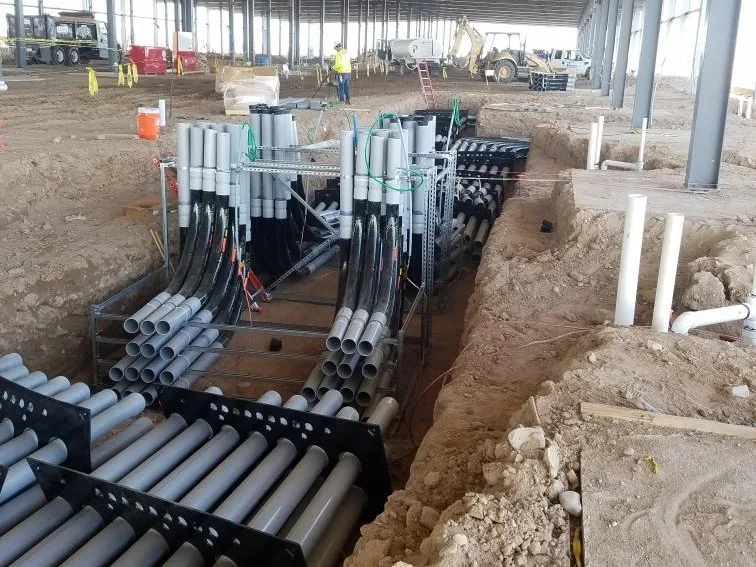
Duct bank of PVC conduit sweeping up into a strut rack of organized stub-ups inside a steel-framed building
Every conduit lands where the equipment expects it.

Mission critical · Data center

Iron Mountain Data Center

Sturgeon Electric / Holder Construction

  • 2,500+Ft of hard dig, power
  • 4,100Ft of hard dig, comms
  • 244-inch conduit configuration
  • 4,000+Cu yd ready-mix backfill

Hard dig for medium- and low-voltage conduit, plus a twenty-four-way communications bank, on an accelerated schedule.

Mission critical · Data center

Zayo Dallas DC 01

JDCM

  • 28,975Ft of 4-inch duct bank
  • 4,450Ft of 2-inch duct bank
  • 15,650+Ft of 1-inch controls conduit
  • 1,940Ft of excavation and trench

Excavation, trench and duct bank installation for power and controls, with concrete and slurry placed over the runs. Accelerated schedule.

02 — Solar & renewables

Trenching for utility-scale solar and renewable energy

Solar underground is a production job. The quantities are measured in thousands of feet, the trench carries several systems at once and the bedding matters as much as the dig.

What the underground scope looks like

A solar field collects DC power from the arrays, converts it and sends AC power toward the point of interconnection. Much of that cable is direct-buried, which means it sits in the trench without conduit and depends on clean bedding below and shading material above to protect the jacket. Fiber for monitoring and a grounding conductor usually share the same trench at different levels.

What makes it hard

Layers. Each lift of cable has to be placed, shaded and checked before the next one goes in, so the trench stays open longer and the sequence has to hold across a very large site. Trench widths change as circuits combine. Sites are often remote, and native desert soil is rarely fit to put back against cable without screening or imported material.

What we bring

Renewable energy contractors have been part of our customer base since 2004. We bring production trenching in any width the design calls for, rock trenchers for hard desert ground and our own trucks for hauling material in and spoils out.

03 — Aviation

Airport underground infrastructure that keeps the airport open

An airport does not stop for construction. Underground work there is planned around operations, access and decades of existing utilities, some of them better documented than others.

What the underground scope looks like

Power and low-voltage raceways for terminals, people-movers and support buildings, usually in concrete-encased duct banks with manholes along the route. Before new work can start, existing lines in the way often have to be relocated and kept in service while they move.

What makes it hard

  • Work areas and hours set by airport operations, not by the trench.
  • Crowded corridors where power, fiber, fuel and water already run.
  • Encased systems with rebar, where conduit spacing and alignment are inspected before concrete.
  • Live communications lines that have to keep working during a relocation.

What we bring

We built raceways for the PHX Sky Train at Phoenix Sky Harbor and relocated fiber ahead of its second phase. We can locate what is already there with vacuum excavation and potholing, build encased duct banks and dig for manholes and vaults.

Aviation · Phoenix Sky Harbor

PHX Sky Train

DP Electric / McCarthy-Hunt JV

  • 145-inch encased conduits
  • 44-inch encased conduits
  • 16+Manholes
  • T4 → T3Segment completed

Excavation and installation of the power, propulsion and low-voltage raceways between Terminal 4 and Terminal 3, in a rebar-and-concrete encased system.

Aviation · Fiber relocation

Sky Train Phase 2 fiber relocate

Wilson Electric / Hensel Phelps

  • 5,400+Ft of fiber rerouted
  • City of PhoenixFiber owner

City of Phoenix fiber moved out of the way so the Sky Train could be built through to the rental car facility.

04 — Healthcare

New utility feeds for hospitals and healthcare campuses

Healthcare work is usually an addition to something that is already running. The new feed has to reach the building without interrupting the ones that keep it open.

What the underground scope looks like

Primary and secondary electrical feeds from the utility to new or expanded buildings, communications conduit, and site lighting for parking and walkways. The primary side is built to the serving utility's specifications and inspected by the utility before it is covered.

What makes it hard

Campuses grow in phases, so the ground holds layers of existing power, medical gas, water and data. Patients, staff and emergency vehicles keep moving through the site, and routes that look open on paper cross paths that cannot be blocked.

What we bring

In congested and unknown areas, vacuum excavation and potholing finds existing lines before a bucket does. Where a driveway or entrance has to stay open, horizontal directional drilling crosses under it. When the conduit is in, we coordinate sidewalk, curb and asphalt restoration so the campus gets its surface back.

On record: Banner Behavioral Health

For Delta Diversified and Oakland, working in conjunction with APS (Arizona Public Service), we trenched for a new primary and secondary feed through a highly congested area with critical paths. We installed all underground conduit systems to the specification the utility required.

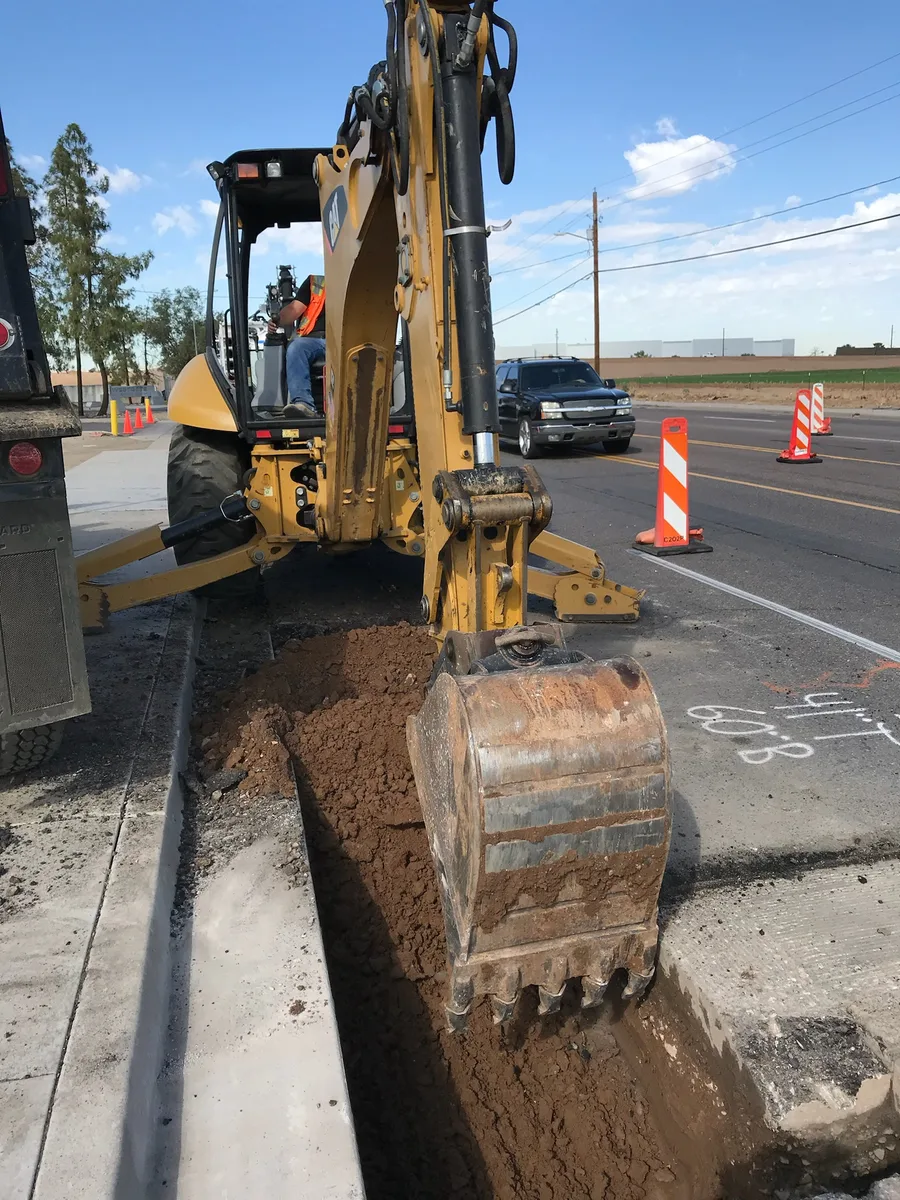
Backhoe digging a narrow utility trench along a saw-cut road edge beside curb and gutter, with traffic delineators in place
A narrow trench along a saw-cut edge, with traffic control set.

05 — Military & federal

Underground power distribution for military and federal sites

On federal work the specification is the job. The trench is judged against the agency's documents, and the paperwork is part of the installation.

What the underground scope looks like

Primary, secondary and low-voltage infrastructure for new facilities: medium-voltage raceways, service raceways to each building and communications conduit, often with the local utility and the agency each responsible for part of the system.

What makes it hard

Two sets of standards can apply to the same trench, the agency's and the utility's, and they have to agree before conduit goes in. Site access is controlled, inspections are formal and changes move through a defined process. Crews that are used to solving problems in the field have to solve them on paper first.

What we bring

A documented process from hand-off to close-out, with daily trench inspections recorded digitally and a quality team that visits the job while there is still time to adjust. In the field that means trenching and conduit installation built to the drawings, and a safety program that does not change with the size of the project.

06 — Commercial & hospitality

Commercial, mixed-use and hospitality underground utilities

From a casino on open ground to a basement in downtown Phoenix, commercial work is about getting service to the building on the day the building needs it.

Scope

What it looks like

Medium-voltage raceways to the service entrance, secondary and low-voltage conduit across the site, communications service, and trench plus pole bases for parking lot lighting and cameras.

Difficulty

What makes it hard

Downtown, there is no room. Trenches run deep beside existing buildings, under streets full of older utilities, with traffic and neighbors a few feet away. On open sites, the difficulty is sequence: underground has to finish ahead of paving, curbs and landscape.

Premier

What we bring

The whole sequence in one contract: saw-cutting and demolition, turnkey dry utility construction, site lighting trench and augering, and restoration of what we cut.

Mixed-use · Downtown Phoenix

Block 23

Delta Diversified Enterprises / Whiting-Turner

  • 405-inch conduits
  • 18 ftDepth of run
  • 2 wksSchedule
  • 2Basements connected

Power had to reach the new Block 23 basements from the existing Block 22 building. We ran forty 5-inch conduits between them at eighteen feet deep, in downtown Phoenix conditions, on a two-week schedule.

Hospitality · Casino

West Valley Casino, Phase 1

Delta Diversified / Hunt-Penta JV

  • MVMedium-voltage raceways
  • AllElectric and low-voltage dry utilities

Medium-voltage underground raceways and all electric and low-voltage underground dry utilities for the first phase, which was built to serve as the temporary casino.

07 — Residential development

Dry utilities for new communities and subdivisions

In a new community the dry utilities usually share one trench. Power, gas, telephone, cable and street lighting go in together, which is why the work is often called joint trench.

What the underground scope looks like

A main-line trench along the streets with each utility at its own depth and separation, crossings under future roadways, service laterals to the lots, and pads, pull boxes and street light bases along the way. Each utility inspects its own part before backfill.

What makes it hard

Timing. Dry utilities usually follow the wet utilities and have to finish before curb and paving, phase by phase. Several utility companies inspect the same trench on their own calendars, and a missed inspection holds up everything behind it.

What we bring

Premier Underground has provided underground utility work for residential developers and builders since 2004. We run the trench as one scope, so you are not coordinating a digger, a conduit crew and a hauler around each inspection.

Ask us for references

We do not list a residential project here because our published project history covers other sectors. If you are a developer or builder, request a quote and ask for current residential references.

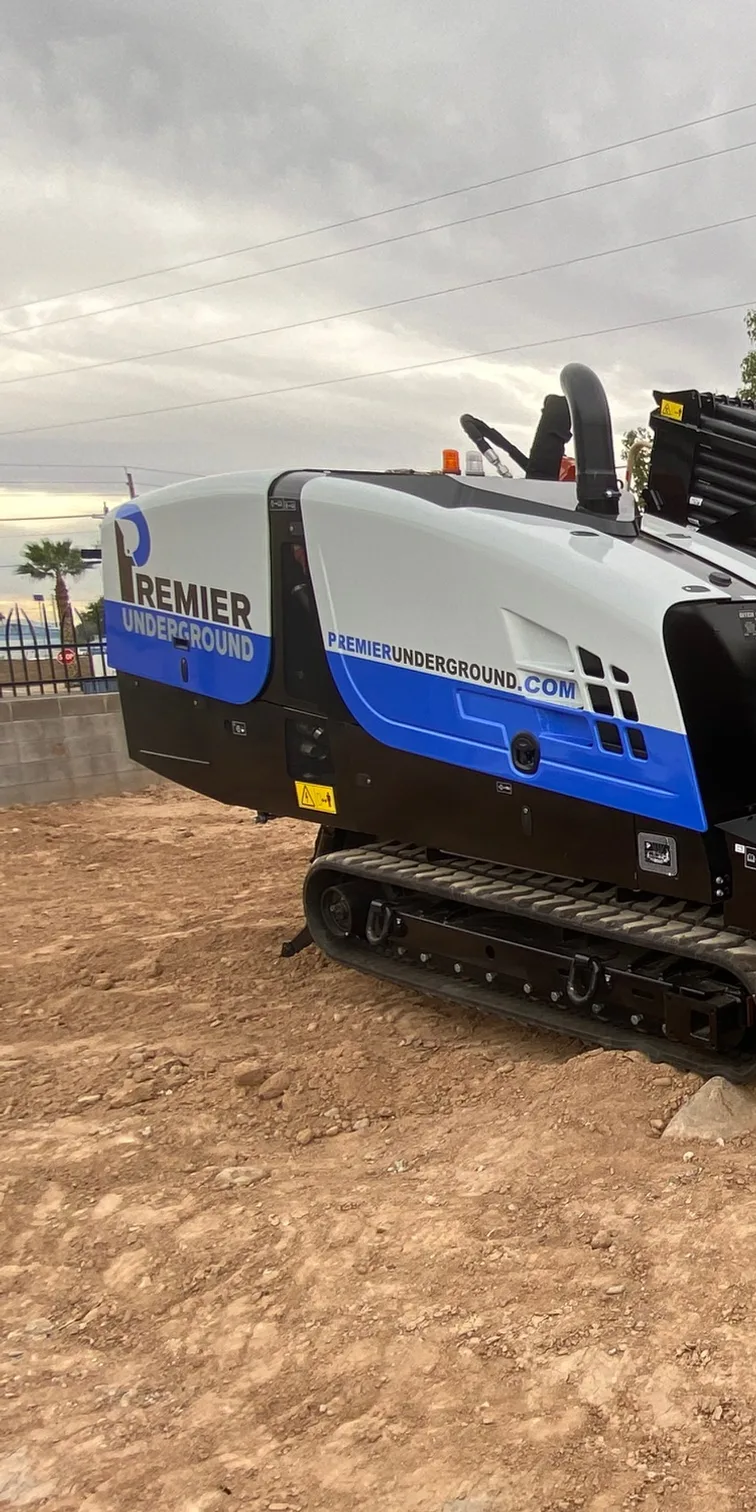
Horizontal directional drill rig on rubber tracks in Premier Underground livery
One of our directional drill rigs, used for crossings where the surface has to stay intact.

08 — Telecom & fiber

Fiber conduit, relocations and crossings

Communications work is long, shallow and close to everything else in the right-of-way. The skill is in getting through without touching what is already there.

What the underground scope looks like

Conduit and pull boxes for fiber and copper, communications duct banks into buildings, and relocations when an existing line sits in the path of new construction.

What makes it hard

Routes follow streets and easements that already hold gas, water, power and other carriers. Roads and driveways along the way have to stay open. A relocated line has to be ready before the old one is cut over.

What we bring

For Sky Train Phase 2 at Phoenix Sky Harbor, we rerouted more than 5,400 feet of City of Phoenix fiber, working for Wilson Electric and Hensel Phelps, so the train could be built through to the rental car facility. We use directional drilling when open cut is not possible, vacuum excavation to expose existing lines safely and open trench where the route allows it.

Next steps

Your job. Your way.

Do not see your sector? The scopes are the same ones. If it is power or communications and it goes in the ground in Arizona, we would like to look at it.

Your job. Your way.

Tell us what you are building.

Send the drawings and the schedule. Our preconstruction team will price the underground scope for your sector and your site.

Premier Underground Construction, LLC
575 N Eliseo Felix Jr Way, Avondale, AZ 85323
623-748-9650 · estimating@premierunderground.com
Serving all of Arizona since 2004