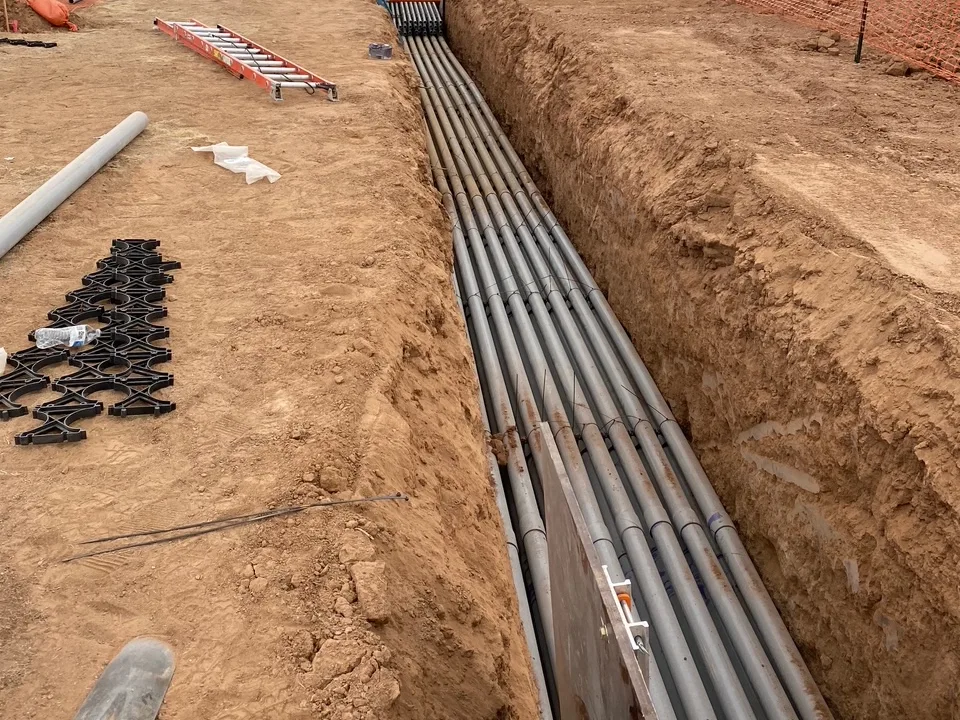
Medium-voltage, low-voltage and communications raceways, concrete-encased or direct-buried. We dig it, set it, encase it and close it, with manholes, vaults and stub-ups where the drawings call for them.
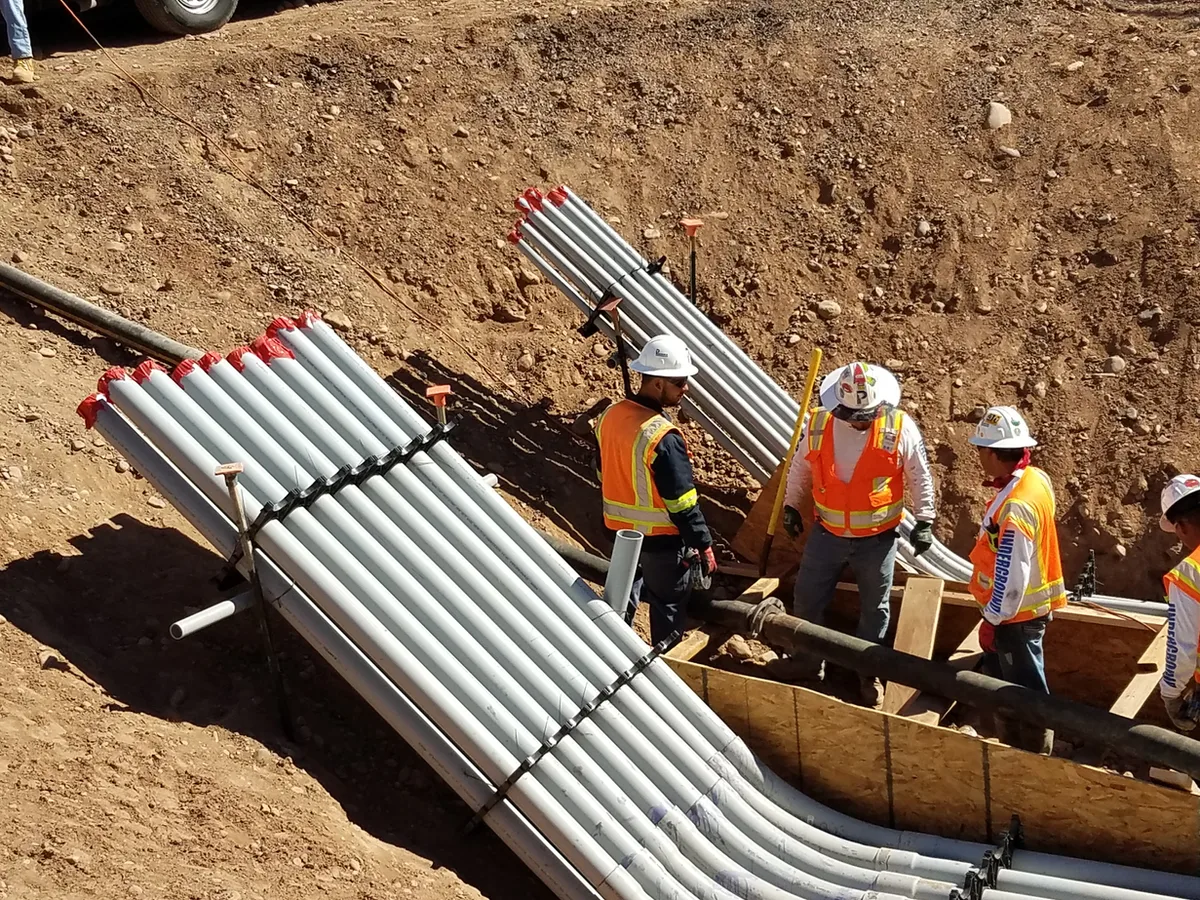
Setting banks of PVC conduit in an open excavation.
In short
A duct bank is a group of conduits installed together in one trench, held at a fixed spacing and either encased in concrete or buried in select material. It gives power and communications cables a protected path underground between equipment, manholes and buildings. Premier excavates, builds and backfills duct banks across Arizona.
01 — Definition
What is a duct bank, and when do you need one?
You need a duct bank whenever several conduits have to travel the same route below grade: a utility feed to a switchgear room, feeders between buildings on a campus, a communications backbone into a data hall, or raceways between manholes along a transit line.
Grouping the conduits does three things. It keeps them at a consistent spacing from end to end. It protects them from loads above and from the next person who digs. And it leaves a known, repeatable path, so cable can be pulled now and replaced later without opening the ground again.
A single conduit run, such as a site lighting circuit or a low-voltage service, follows the same rules on a smaller scale. We install both, usually as part of a larger turnkey dry utility package.
02 — Encased or direct-buried
Concrete-encased or direct-buried duct bank?
The specification or the serving utility makes the call. Both methods start with the same trench. They differ in what surrounds the conduit, and we build either.
Concrete-encased
Direct-buried
What surrounds the conduit
Concrete or slurry placed around conduits held on spacers, with reinforcing steel where the design calls for it
Bedding below and shading above, in layers, then native or imported backfill
Commonly specified for
Medium-voltage feeders, mission-critical power, runs under roads and heavy traffic
Long runs in open ground, solar collection systems, lighter-duty circuits
Main advantage
Strong protection against loads and future excavation
Faster to place and lower in material cost over distance
What it adds to the job
Concrete delivery and placement, and conduits secured so they do not float or shift during the pour
Bedding and shading material in volume, and careful layering between circuits
From our project list
Phoenix Sky Train: rebar and concrete encased 5-inch and 4-inch conduit system
Mohave Solar: over 3,200 yards of bedding and shading material for direct-buried DC and AC
03 — Scope
What our duct bank and conduit scope includes.
Everything from the excavation to the stub-up. You get one contractor for the hole, the raceway and the backfill.
Medium-voltage raceways. Primary feeds and distribution duct banks, built to the specification of the utility provider or the project engineer.
Low-voltage and service raceways. Secondary feeds, service entrances and site lighting conduit.
Communications conduit. Telephone, cable and fiber pathways, from a single run to a twenty-four-way bank.
Controls conduit. Small-diameter conduit for controls, routed with the main bank.
Manholes and vaults.Excavation for the structure, then conduit tied into it.
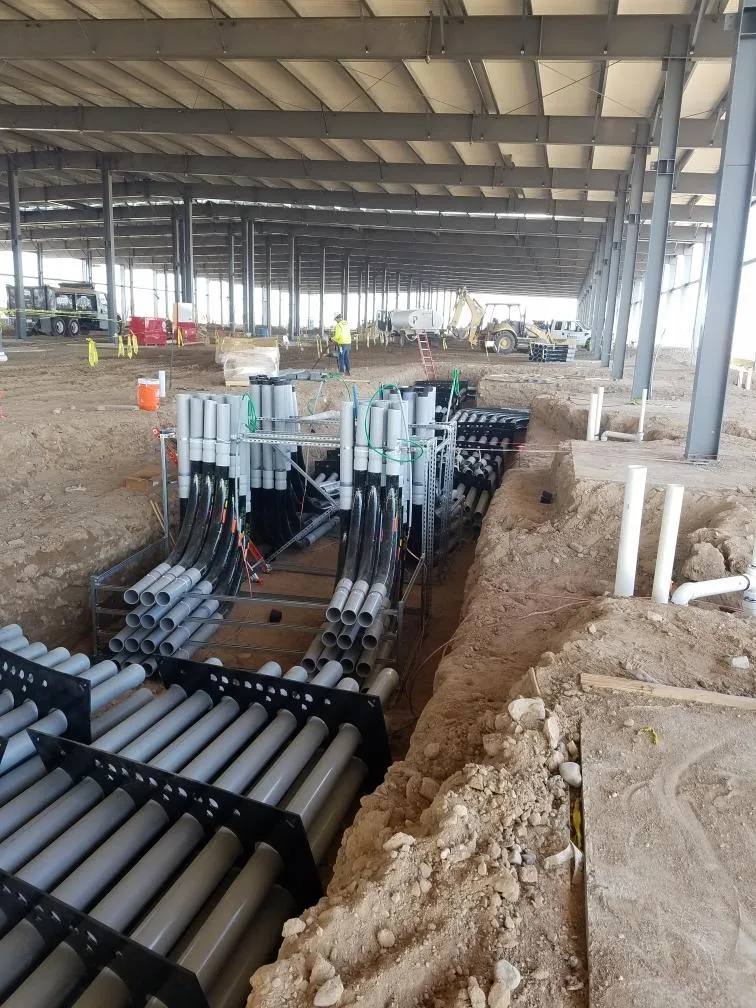
Stub-ups. Conduits swept up out of the bank and held in line where the equipment will land.
Encasement and backfill. Concrete, slurry or ready-mix backfill where specified. Bedding and shading where it is not.
A duct bank turning up into racked stub-ups inside a building.
04 — Method
How we build a duct bank.
A duct bank is easy to draw and unforgiving to build. Once the concrete is placed or the trench is closed, nothing can be adjusted. So the checking happens before that point.
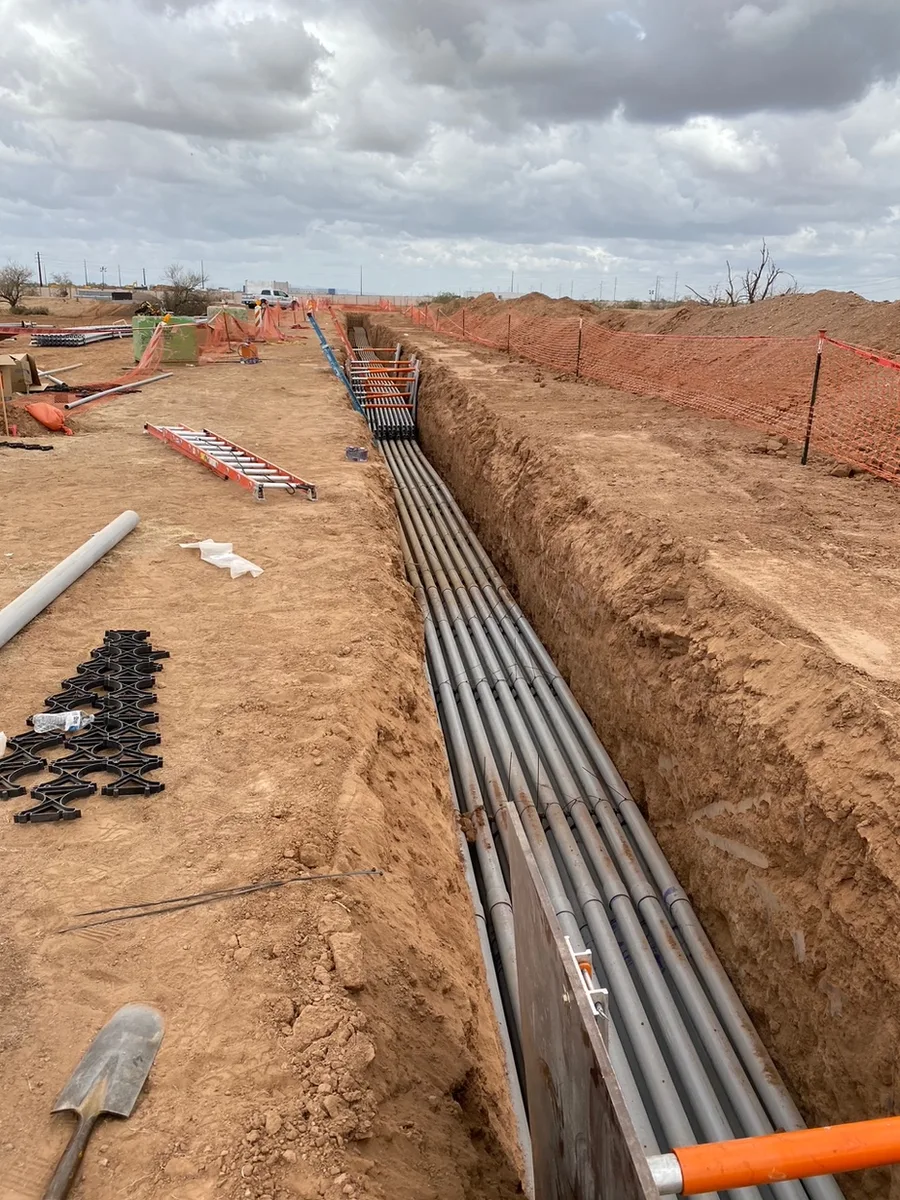
Conduit on spacers, straight and ready to be checked before it is covered.
Preconstruction
Take off the real bank
Estimators price the conduit counts, the excavation, the concrete or select material, the ground conditions and the restoration. The scope is then handed off in writing to the project manager.
Layout
Find what is already there
The route is laid out and existing utilities are exposed by vacuum excavation where the area is congested or unknown.
Excavation
Open and protect the trench
We dig to the width and depth of the section. Our rules apply on every trench: spoils 3 feet back, a way in and out at 4 feet, trench protection at 5 feet. The trench is inspected daily.
Conduit
Set the bank on spacers
Conduit goes in row by row at the spacing shown on the drawings, with sweeps, tie-ins to manholes and vaults, and stub-ups set where the equipment will land.
Quality
Check it while it is open
Quality control visits the job while there is still time to adjust direction, not after the work has to be redone. Findings are written up in a quality control report.
Encase
Encase or shade, then mark
Concrete or slurry is placed around an encased bank. A direct-buried bank gets its shading material. Either way the line is marked for whoever digs next.
Close out
Backfill, haul off, walk it
The trench is backfilled, spoils leave in our trucks and the surface is restored. Operations and quality control walk the finished work together before close-out.
05 — Proof
Duct bank projects, in conduits and feet.
Two data centers, a downtown basement connection and an airport people-mover. The quantities come from our own project records.
A two-week schedule to bring power from the existing Block 22 basements to the new Block 23 basements. Forty conduits, eighteen feet down, in downtown Phoenix conditions.
Aviation · Phoenix Sky Harbor
PHX Sky Train
DP Electric / McCarthy-Hunt JV
14 + 45-inch and 4-inch encased conduits
16+Manholes
Excavation and installation of the power, propulsion and low-voltage raceways from Terminal 4 to Terminal 3, as a rebar and concrete encased conduit system.
Mission critical · Data center
Zayo Dallas DC 01
JDCM
28,975Ft of 4-inch duct bank
4,450Ft of 2-inch duct bank
15,650+Ft of 1-inch controls conduit
1,080Yd of concrete and slurry
1,940 feet of excavation and trench carrying 4-inch and 2-inch duct bank and Schedule 40 controls conduit, on an accelerated schedule.
Mission critical · Data center
Iron Mountain Data Center
Sturgeon Electric / Holder Construction
244-inch conduit comms bank
4,000+Cu yd ready-mix backfill
Medium- and low-voltage conduit and a twenty-four-way communications configuration through more than 6,600 feet of hard dig, on an accelerated schedule.
06 — Fit
Where our duct bank crews are most useful.
We are most useful where the bank is big, deep, on a short schedule, or all three. Those are the jobs where owning the excavators, the hammers and the trucks matters, because nothing waits on a rental or another subcontractor.
Data centers, with large conduit counts and accelerated dates.
A duct bank trench is often deep, and people work inside it. Our core rules do not change with the size of the job: spoil distance at 3 feet, ingress and egress at 4 feet, trench protection at 5 feet, fall protection at 6 feet.
Our quality team lives by the 20-60-20 rule: 20 percent challenge, 60 percent solution, 20 percent coaching. When a visit finds a deficiency, the fix comes with training so it does not repeat on the next bank.
A duct bank is a group of conduits installed together in one trench and held at a fixed spacing. It gives power or communications cables a protected underground path between equipment, manholes, vaults and buildings. A duct bank can be encased in concrete or direct-buried in bedding and shading material.
When should a duct bank be concrete-encased instead of direct-buried?
The project specification or the serving utility decides. Concrete encasement is common for medium-voltage feeders, mission-critical power and runs under roads or heavy traffic, because it protects the conduits from loads and from future digging. Direct burial in bedding and shading material is common on long runs in open ground, such as solar fields.
Does Premier Underground do the excavation and the conduit installation?
Yes. Premier Underground excavates the trench, places the bedding, sets the conduit, encases or shades it, backfills and restores the surface. The same contractor also handles hard dig, spoils haul-off and manhole excavation, so the duct bank is one scope instead of several.
What sizes of duct bank has Premier Underground installed?
Completed work ranges from 1-inch controls conduit to banks of forty 5-inch conduits. Examples include forty 5-inch conduits at a depth of 18 feet at Block 23 in downtown Phoenix, and a twenty-four-way bank of 4-inch communications conduit at the Iron Mountain Data Center.
Who does Premier Underground install duct bank for?
Most duct bank work is done as the underground subcontractor to an electrical contractor, with a general contractor above them. Premier Underground also works directly for general contractors, developers and renewable energy contractors anywhere in Arizona.
Send the duct bank sections, the site plan and your dates. We will price the excavation, conduit, encasement and backfill as one number, and build it with one crew.